Opossum Wire: Because Asking Your Neighbor for Help Shouldn't Require an Algorithm
Introducing a community communications platform for the Staunton hOUR Economy, Queen City Resiliency Salon, and anyone interested in making the Shenandoah Valley a little more connected.
Welcome to Opossum Wire! Here's your map:
This is part project introduction, part onboarding guide, and part enthusiastic argument that perhaps we shouldn't have to surrender our personal information and emotional well-being just to find out when the next community potluck is happening.
There's a little economics, a little technology, some practical demonstrations, and a healthy amount of complaining about legacy social media.
But I promise there's a point to all of it.
Not interested in the rant? Darling, I respect your time. Skip ahead!
Choose your own adventure
- Why I built Opossum Wire — The curious case of a time bank full of people offering help, with nobody asking for it.
- What can you actually do with it? — Service requests, Repair Cafés, the community calendar, and future barter markets, with screenshots.
- The trouble with legacy social media — Surveillance, engagement algorithms, social pollution, and the economics of getting everybody mad at everybody else.
- Why Nostr? — How open protocols, local control, and decentralized infrastructure offer another way to organize.
- Watch the onboarding video — Skip straight to the walkthrough and learn how to join.
- Explore the wider Nostr universe — Zaps, recipes, Bitcoin tipping, and other delightful experiments.
- Get involved — Join the community and put the network to work.
Read the whole thing, jump around, or go directly to the video. The goal isn't to keep you scrolling.
We've had quite enough of that business already.
We have plenty of people willing to help. Now we need people to ask.
Since reviving the Staunton hOUR Economy, I've heard from quite a few people offering their skills and services. People want to repair things, teach things, grow things, and generally be useful to their neighbors.
Wonderful! That's exactly what I hoped would happen.
But in 2026, nobody emailed to ask for help. Not one person. Apparently, we're a community full of people ready to lend a hand, politely waiting for somebody else to need one.
The previous iteration was burned by subscription apps, and the prior leadership said if they had to do it over again they would make it simple and physical. Our version of hOUR Economy began with a simple HTML website, physical tokens representing hours of service, and gatherings where people could meet and exchange skills. The tokens have gradually circulated through those relationships and events.
That personal foundation matters. But there's a difference between meeting someone at an event and remembering three weeks later that they offered to help fix a bicycle.
And there's a difference between casually asking a group of neighbors for help and composing an email to the person running the time bank, who then has to coordinate the whole affair.
I suspect we've made offering help easier than asking for it.
So I built something to address that. It's called Opossum Wire.
What can you actually do with Opossum Wire?
Before I explain the technology, let's look at what it's for. Because nobody should need a lecture about cryptographic protocols just to find someone who knows how to fix a lawnmower.
1. Ask for help through the hOUR Economy
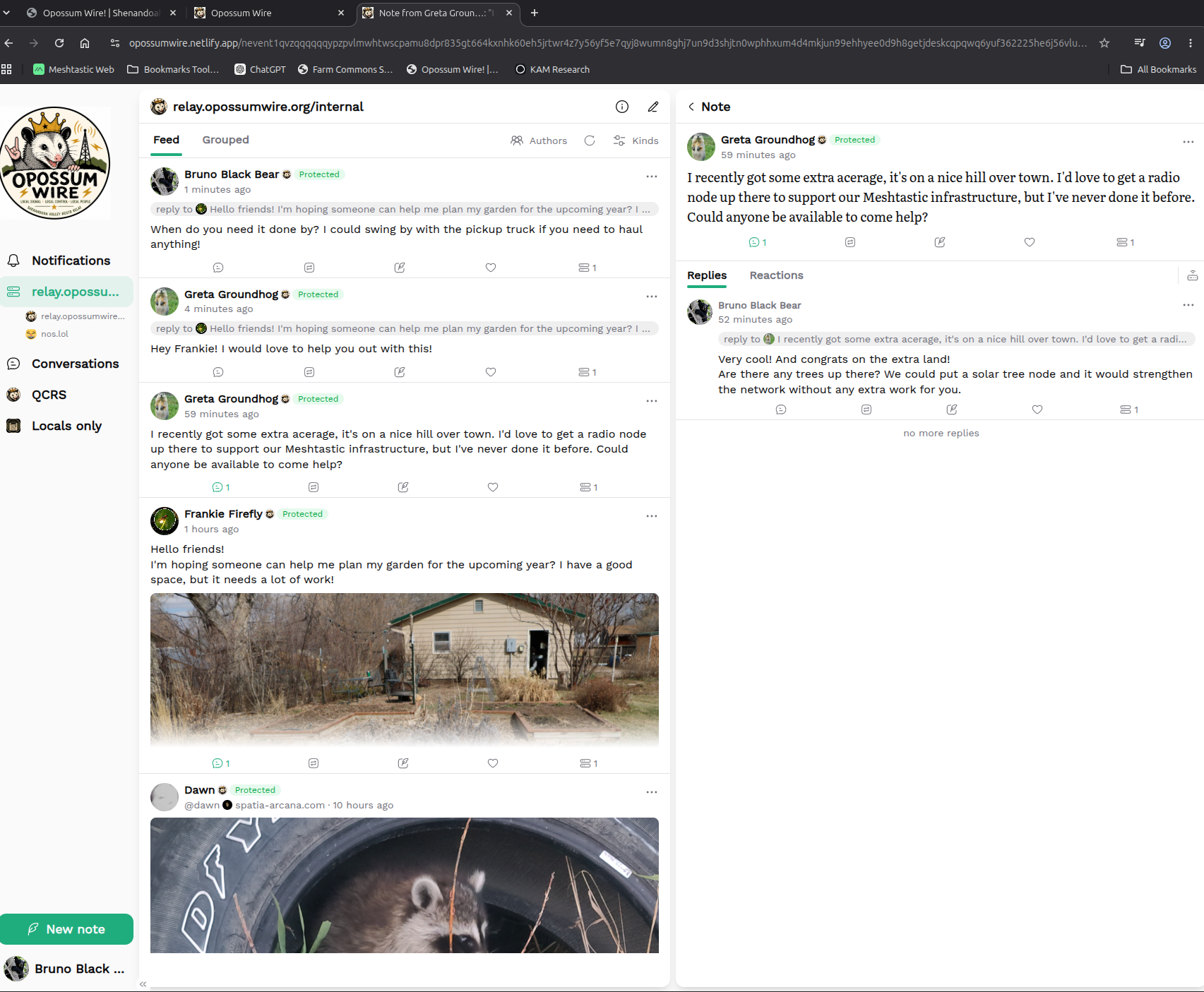
Imagine needing help with a small household project. Instead of emailing me and waiting for me to play matchmaker, you can post your request directly where other participants can see it.
Maybe you need help moving furniture, repairing a bicycle, planting a garden, or figuring out why your computer has suddenly decided that functioning is optional.
Someone with the relevant skills can respond, and you can work out the details together.
The idea isn't to eliminate personal relationships. Quite the opposite. It's to make it easier for those relationships to begin.
A time bank needs both sides of the exchange. We've already discovered that people are willing to contribute. Now let's make asking for assistance feel as ordinary as offering it.
2. Get help at the next Repair Café
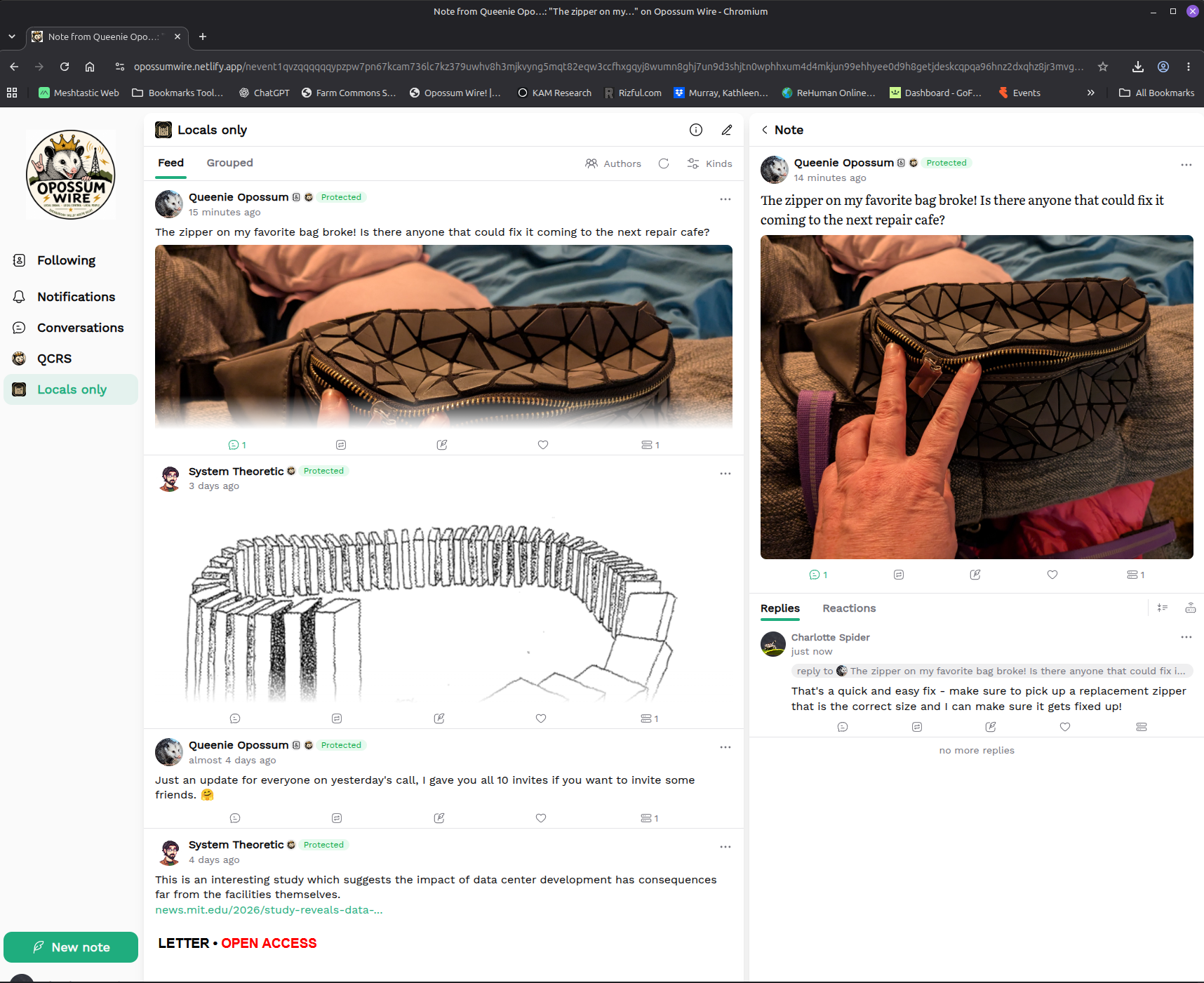
Our Repair Cafés are another example of community exchange in action. People bring broken household items, and volunteers share their skills to help diagnose or repair them.
But what if someone wants to know whether a particular repair is possible before showing up?
They could post a photograph and a description. Perhaps a volunteer recognizes the problem, suggests bringing a replacement part, or knows someone with the appropriate tools.
Now the event becomes more than a few hours in a room with screwdrivers. The conversation can begin beforehand and continue afterward. And maybe somebody learns enough to help with the next repair. That's how skills spread.
3. Find something interesting on the community calendar
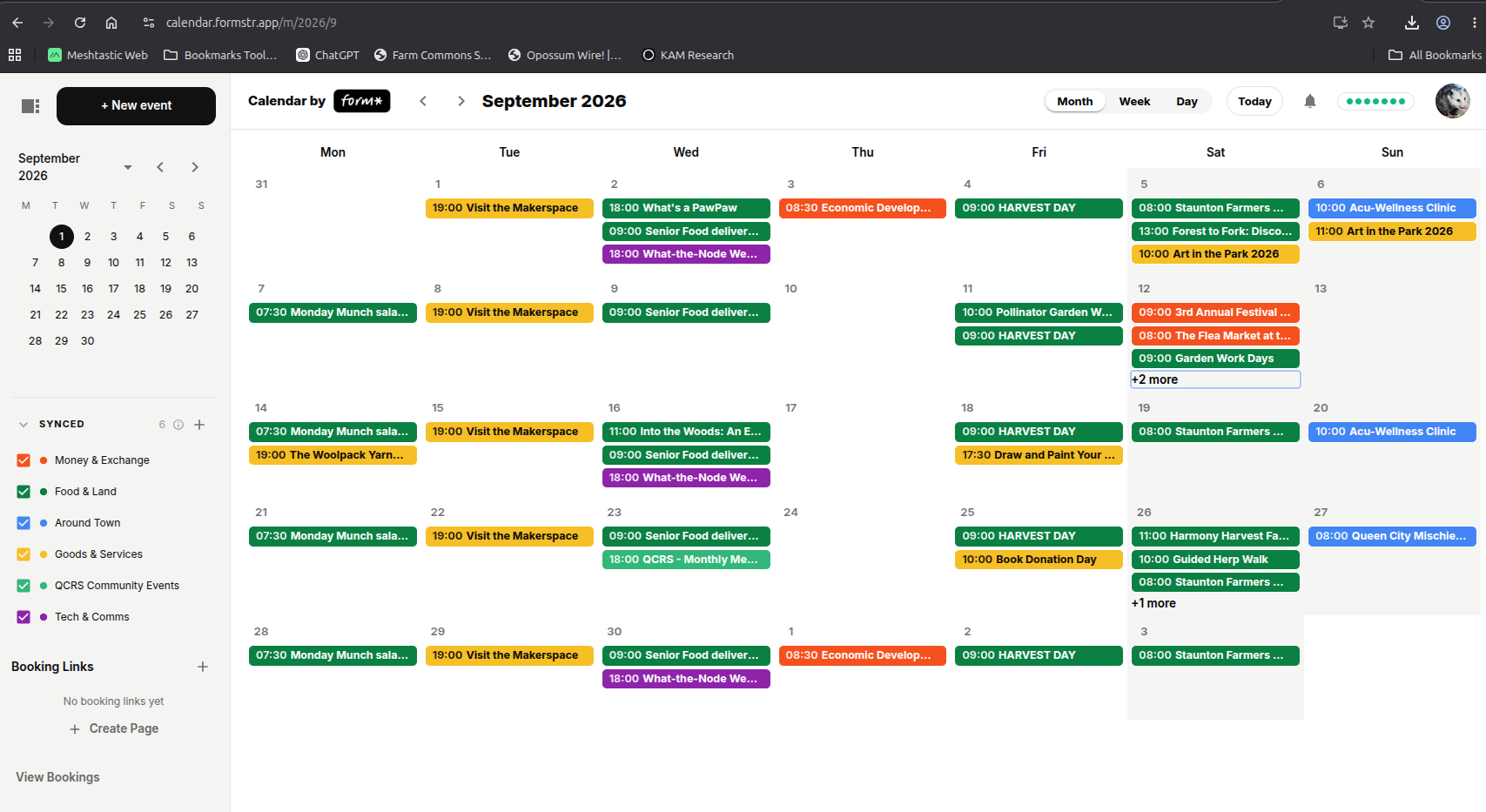
There are so many interesting things happening around the Shenandoah Valley, but discovering them can feel like a scavenger hunt organized by seventeen different websites and a Facebook algorithm that thinks you'd rather watch someone argue about a parking space.
I'd like one place where people can discover farm workdays, Repair Cafés, Linux workshops, crafting events, barter markets, community potlucks, nonprofit fundraisers, and whatever else our neighbors dream up.
The goal is to turn scattered events into a more visible network of opportunities to participate.
4. Organize barter markets and find people to trade with
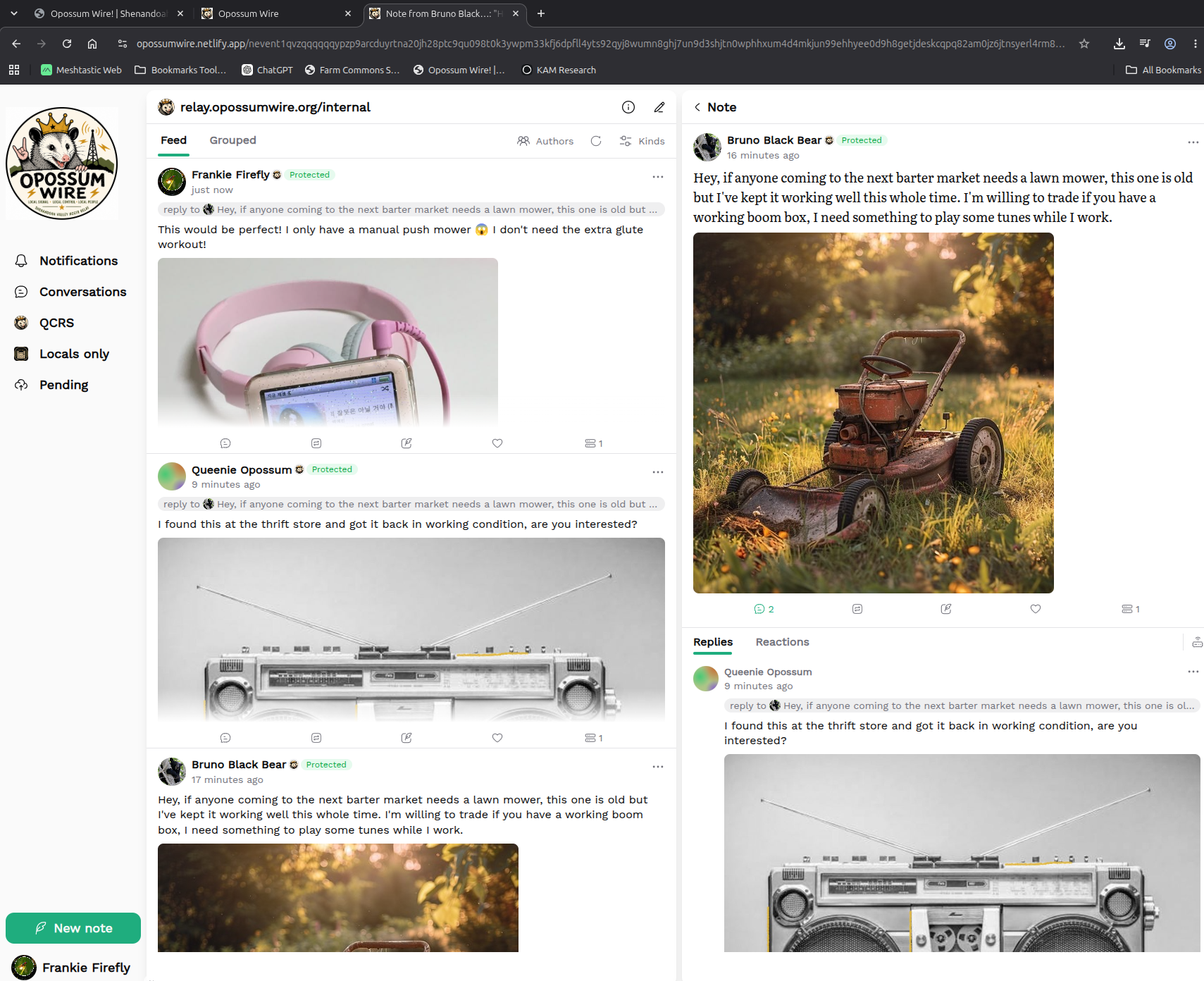
One of the possibilities we're exploring through the Queen City Resiliency Salon is bringing barter markets back into regular community life. We've already had encouraging conversations about hosting these events in Staunton, including the possibility of holding up to four markets per year. But organizing a barter market presents an interesting little problem: how do you know what people want to trade before everybody shows up?
Opossum Wire could help us coordinate that.
Maybe someone has extra garden produce and wants to exchange it for handmade soap. Someone else has a collection of tools they no longer need. Another person makes beautiful things but would really appreciate help repairing their porch.
People could discuss what they have, what they're looking for, and what kinds of exchanges they'd like to see at an upcoming market.
The point isn't to replace face-to-face trading. It's to make those gatherings easier to organize, more useful to participants, and more likely to become a regular part of local economic life.
A barter market shouldn't require everyone to show up with a trunk full of mystery objects and hope for the best. A little coordination beforehand could make the whole experience much more productive.
And if we can help people discover what their neighbors have to offer, we might just find that our local economy is richer than we realized.
They privatized the town square and started charging admission to your own life
Now comes the obvious question.
Why build a new communications platform when Facebook, Instagram, Discord, and plenty of other services already exist?
Because I'd rather not build our community's communications infrastructure on top of somebody else's advertising business.
There's an old saying that if you're not paying for a product, you are the product.
Catchy, but economically incomplete.
On commercial social media, you're also part of the workforce. You create the content, supply the photographs, write the commentary, and provide the relationships that make the network useful. Then the platform sells advertising alongside your activity.
What a marvelous business.
Imagine opening a restaurant where customers bring their own food, cook it, entertain one another, clean the tables, and thank you for letting them eat there.
Now imagine charging advertisers to interrupt dinner.
That's social media.
The surveillance
In September 2024, the Federal Trade Commission published A Look Behind the Screens, documenting extensive collection of personal information by major social media and video-streaming companies, including activity beyond their platforms.
Your clicks. Searches. Interests. Shopping habits. Location signals. Information obtained from other companies. Even inferences about you that you never volunteered. The platforms use that information to predict what you'll click, buy, watch, fear, or desire.
Economists call the underlying imbalance information asymmetry. The platform knows a great deal about your behavior. You know comparatively little about how it evaluates you.
That's playing poker against someone who can see your cards and has already calculated how much you're willing to lose.
And the same information can influence what businesses charge.
In January 2025, the FTC released preliminary findings on surveillance pricing, examining how intermediaries could use personal information, including location and shopping behavior, to help tailor prices.
First the machine learns what you want. Then it learns how badly you want it. Then, potentially, it figures out how much extra it can charge before you say, "Excuse me, absolutely not."
Why is the internet constantly trying to start a fight with me?
Have you ever opened social media feeling cheerful and emerged twenty minutes later convinced civilization is collapsing because someone in Ohio has an opinion about lawn decorations?
Congratulations! You've experienced engagement optimization.
Platforms can measure clicks, shares, comments, and time spent watching much more easily than they can measure truth, usefulness, or human flourishing. So they optimize what they can count. And guess what gets engagement?
Anger. Fear. Hostility. Political tribalism.
A thoughtful explanation of how to improve stormwater drainage might help hundreds of neighbors.
A video screaming that your enemies are DESTROYING CIVILIZATION?
Oh, honey. That one has engagement written all over it.
Research on political content sharing has found that hostility toward political opponents is particularly effective at generating engagement. Other research has found that engagement-based ranking can amplify emotionally charged content, even when users don't particularly want to see it.
The machine is essentially saying, "I know you SAY you want meaningful information, but have you considered being absolutely furious about a stranger's opinion?"
No, algorithm. I have not. And I would like my afternoon back.
The social pollution nobody has to clean up
Economists call it a negative externality when a business earns the benefits of an activity while someone else bears part of the costs.
A factory collects revenue; the neighborhood deals with polluted water.
An attention platform collects advertising revenue from content that keeps us arguing. Families, friendships, schools, and communities may bear the costs of hostility, misinformation, and fractured relationships.
Call it social pollution.
The platform collects the advertising revenue. The rest of us get Thanksgiving dinner.
And there's an opportunity cost, too. Imagine three free hours on Saturday. You could repair a bicycle, volunteer in a garden, help a neighbor, or organize a community project.
Or you could spend all three discovering that someone in another state has an intolerable opinion. Decisions, decisions.
Local civic work is slow and occasionally involves people who cannot remember who was supposed to bring the extension cord. But it has one extraordinary advantage: It can change the place where you live.
National outrage, meanwhile, arrives beautifully prepackaged. It identifies the villains. It tells you which side you're on. It offers a ready-made feeling of moral importance. And it requires remarkably little beyond continued attention. You can feel intensely politically involved while remaining completely motionless on your couch.
The problem is what we might call the substitution of consuming political conflict for exercising political agency.
A person repairing a neighbor's porch? Difficult to monetize.
A person arguing about the porch online?
Engagement GOLD.
Unlike an endless online argument, local action can produce a result. We can absolutely do this. We don't have to accept social pollution as the unavoidable price of being connected. We can demand better systems. And, even more excitingly, we can build them.
Why don't we just leave?
Because everybody's there.
The school, the neighborhood group, the event organizer, your cousin. Leaving means missing things.
Economists call this network effects: a communications service becomes more valuable as more people use it. The more people who join, the harder it is for any one person to leave. Even people who dislike the surveillance, advertising, and algorithms stay because their relationships are there. That's a real obstacle, especially for people with limited time, technical knowledge, or accessibility options.
But network effects can work in the other direction, too.
Every person who joins a useful alternative makes it more useful for the next person. The internet is not Facebook. The internet is not Instagram. The internet is not TikTok. Those are companies operating services on the internet.
The internet itself is an extraordinary network for communication, collaboration, and organizing. No law of economics, physics, or fashion requires our relationships to pass through a corporate advertising machine.
We can choose tools built around different incentives: connection instead of extraction, usefulness instead of outrage, and local relationships instead of endless national arguments.
The internet doesn't need another billionaire. It needs us.
Why Nostr? And why Opossum Wire?
Which brings us back to the technology.
Opossum Wire is built using Nostr, an open communications protocol that allows different applications to exchange information through servers called relays. Unlike a conventional social media account, a Nostr identity is based on cryptographic keys rather than belonging exclusively to a particular website. That means you can use compatible applications with the same identity, and information can potentially be shared across multiple relays.
Opossum Wire is our attempt to make that architecture useful for an actual community.
The larger effort includes the Queen City Resiliency Salon and its connected projects: Farm Commons Shenandoah, the Staunton Repair Café, the Staunton hOUR Economy, and Opossum Wire.
Not anonymous accounts yelling about civilization's imminent collapse. People growing food, repairing things, exchanging skills, sharing information, and organizing projects. People who might recognize one another at the grocery store or need to borrow a tool.
The platform currently depends on hosted infrastructure, and Nostr doesn't magically eliminate privacy risks, technical problems, or the need for responsible administration. But it gives us more flexibility to experiment with local control and alternative infrastructure.
In the longer term, communities in Harrisonburg, Lexington, and elsewhere in the Valley could establish their own local relays and applications, while maintaining connections across the broader network.
Combined with our experiments in LoRa mesh networking and other resilient communications tools, this opens up some interesting possibilities.
I don't expect everything to work perfectly. It certainly doesn't yet.
But I'd rather work through the growing pains of building something useful than spend another decade complaining about platforms whose incentives were never aligned with ours in the first place.
The spirit behind Opossum Wire isn't despair.
It's optimism with a to-do list.
Fine. How do I get on this thing?
I'm glad you asked!
We recently held a group onboarding session to walk through creating a Nostr identity, connecting to Opossum Wire, and exploring the platform together.
The recording is about 50 minutes long. It includes live demonstrations, participant questions, and some very authentic encounters with the occasional technological gremlin.
I decided to preserve those moments because they're useful. If you're confused by something during onboarding, chances are someone else was, too.
Jump to a section
00:00 — Why Opossum Wire?
02:15 — Exploring the community platform
04:55 — Getting started with onboarding
06:05 — Creating a Nostr identity and securing your keys
09:38 — Signing in and requesting local access
14:30 — Questions, mobile devices, and troubleshooting
32:30 — Zaps and the wider Nostr ecosystem
36:34 — Finding and following people
44:00 — Accessibility and future improvements
A word about your keys:
Nostr introduces two terms you'll encounter during onboarding:
npub is your public identifier. You can share it so people can find and follow you.
nsec is your private key. Protect it. Anyone who obtains it may be able to impersonate you or control your identity.
Don't post it, send it to a helpful stranger, or paste it into a website that says, "Trust me, bro."
Compatible signing tools can help you use Nostr without giving every application direct access to your private key. The NIP-07 standard describes one approach used by browser extensions.
And please remember: decentralized does not automatically mean private. Ordinary Nostr posts may be publicly accessible, and a locally focused feed isn't necessarily a confidential conversation.
Follow the recommended onboarding instructions, protect your credentials, and use some common sense about what you share.
Meanwhile, elsewhere in the Nostr universe...
One of the delightful things about Nostr is that Opossum Wire is only one application in a much larger ecosystem.
There are social networking clients, publishing tools, specialized communities, and all sorts of experiments built around the same underlying protocol.
Some are practical. Some are peculiar. Some are probably being invented by somebody who hasn't slept in three days. I respect the enthusiasm.
There are even cooking-related projects, including recipe-sharing communities and experiments such as Zap Cooking.
And then there are zaps.
A zap is a small Bitcoin payment, typically made using the Lightning Network, that can be sent to appreciate someone's content or contribution. I used to be a busker, so I find this concept especially charming.
Imagine somebody sharing a beautiful photograph, a useful tutorial, or a particularly good recipe. Instead of merely clicking a little heart, you can leave them a tiny tip. Like dropping a few coins into a musician's case, except digitally. I've even offered to help interested participants experiment with their first 1,000 satoshis.
None of this is required to participate in the hOUR Economy. You don't need Bitcoin, a Lightning wallet, or any particular enthusiasm for financial experimentation to ask someone to help fix a bicycle.
But it's fascinating to see what becomes possible when people can build applications and exchange value without every interaction being mediated by a single corporate platform.
Get involved
- Edgeless Social Communities
- Staunton hOUR Economy
- Opossum Wire
- Repair Café
- Farm Commons Shenandoah
- Queen City Resiliency Salon
Here's my challenge: join Opossum Wire and make one small request. Ask for a skill, a repair, an extra pair of hands, or a recommendation. Give somebody the opportunity to be useful!
There's just one little catch: Opossum Wire is for local connections, so we need to actually connect.
If we've already met in person, I'm happy to help you get onboarded. If you know someone who's already participating, ask them for an invitation.
And if we haven't met yet? Invite me out for coffee! Say hello at a Queen City Resiliency Salon event. Introduce yourself when you see me around town.
This isn't an exclusive club. It's a community network built on real relationships, and those relationships have to start somewhere.
I'd much rather meet you over coffee than ask you to prove you're human by identifying seventeen traffic lights.
The whole point is to use technology to strengthen our connections in the real world, not replace them.
Opossum Wire is an evolving community experiment. Features, interfaces, and onboarding procedures may change as we continue developing and testing the platform.